Same-day bus tours out of Delhi, priced between ₹299 and ₹899. At that ticket price the margin on a booking disappears into two or three of the wrong clicks — so this account had to be built to exclude before it was built to reach.
India Tourism Incredible runs same-day tours out of Delhi: Delhi
Darshan, Delhi to Agra, Delhi to Haridwar and Rishikesh, Delhi to
Jaipur, and Mathura with Vrindavan. Seats are sold on AC buses, Tata
coaches and Volvo luxury vehicles, from ₹299 to ₹899.
That price point sets every rule that follows. This is not a customer
who researches for three weeks — it is usually somebody already in
Delhi, on a phone, deciding tonight about tomorrow morning. And with a
few hundred rupees of margin on a seat, an account that reaches
everybody is an account that loses money.
A buyer who decides in minutes, on a phone, and wants to call rather than fill a form
A price that has to be visible in the ad, because hiding it only buys clicks that bounce
Two objections to answer up front: is the bus really Volvo, and is that the final price
One operational fact that must reach the visitor before booking — the Agra tour does not run on Fridays
02
The approach
The account was built around routes, not around “tours”. Somebody
searching for a Delhi to Agra Volvo package and somebody searching for
a Delhi Darshan bus are not variations of one customer; they want
different days, different vehicles and different prices, and they
should never see the same ad.
Under each route, the vehicle became its own ad group. A visitor who
typed “Volvo” will not accept a Tata coach, and a visitor
hunting the ₹299 fare will not pay the Volvo fare — so the two get
separate ads, separate landing pages and separate bids.
Then the unglamorous half, which is where the money actually is at this
price point: negative keywords. A tour account attracts an enormous
volume of searches with no booking intent behind them — distances,
timetables, driver jobs, train fares, bus stand maps. Every one of those
clicks is paid for at the same rate as a real one.
Campaigns by route. Agra, Haridwar and Rishikesh, Jaipur, Mathura and Vrindavan, and Delhi Darshan, each held apart.
Ad groups by vehicle. Volvo, AC bus and coach priced and written separately, because the searcher already decided which one they want.
Negatives as a core asset. Jobs, distances, timetables, train and map queries excluded before they can spend anything.
Price in the ad copy. The fare is stated, so the click self-selects rather than arriving and leaving.
Calls and WhatsApp as the conversion. Tracked as first-class actions, because at this ticket size almost nobody fills a form.
Targeting where the customer physically is. Delhi NCR, weighted toward the Paharganj hotel belt this business sits inside.
03
What shipped
Search campaigns split by route, each with its own budget and bid strategy
Vehicle-tier ad groups — Volvo, AC bus, Tata coach — with copy written per tier
Shared negative keyword lists, extended weekly from the search terms report
Call extensions and click-to-call on every ad, with call conversion tracking
Route landing pages carrying the fare, the inclusions and the pickup point
The Friday closure on the Agra tour stated on the page, not buried in terms
Conversion tracking across calls, WhatsApp and the enquiry form before launch
Google Business Profile aligned to the Multani Dhanda address for map searches
04
What changed
A search for a Volvo Agra package now reaches a Volvo Agra page with the
fare on it, instead of a general tours page that asks the visitor to
start hunting. The distance between the query and the answer went to
nearly zero, which at this price point is the entire game.
The negative keyword lists turned out to be the most valuable thing in
the account, and they are the part nobody photographs. On a ₹299
seat, the money saved by not showing an ad is worth as much as
the money made by showing one — and unlike a clever bid strategy, it
keeps compounding every week the list grows.
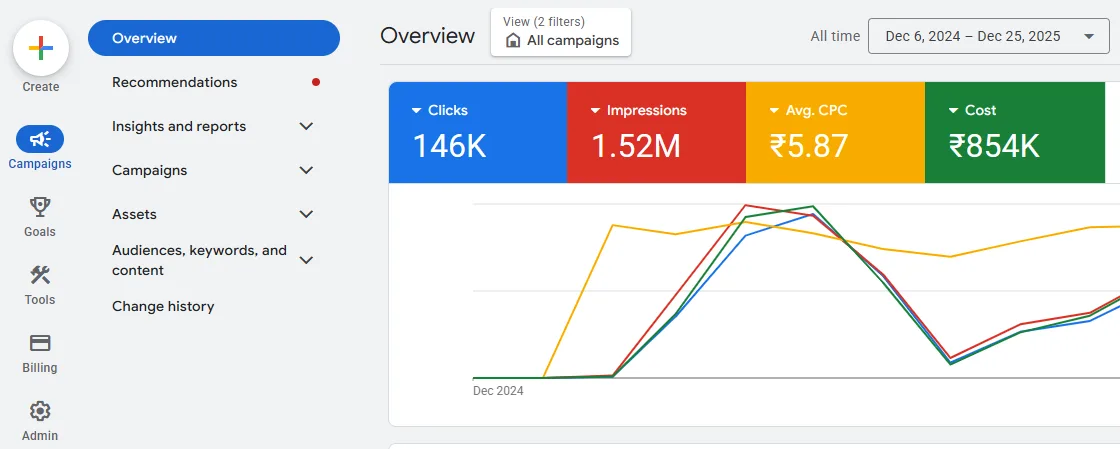
— Evidence
From the account.
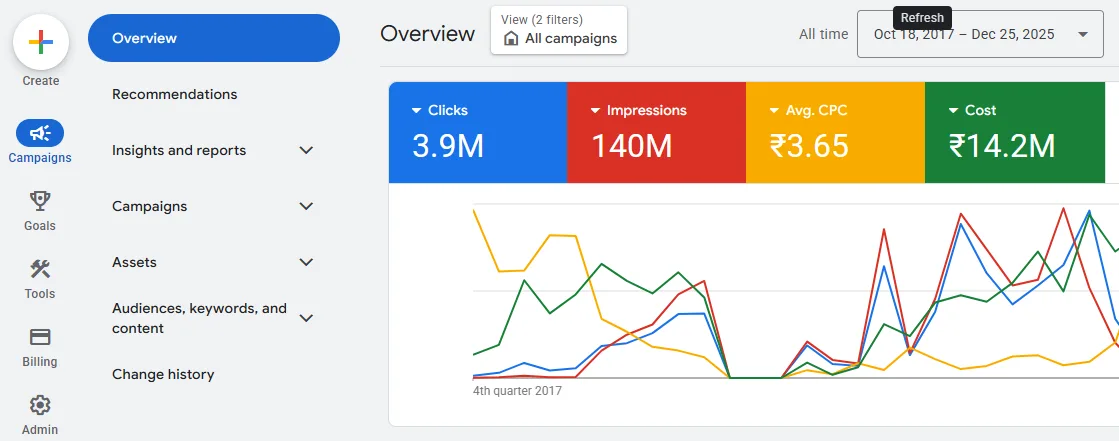
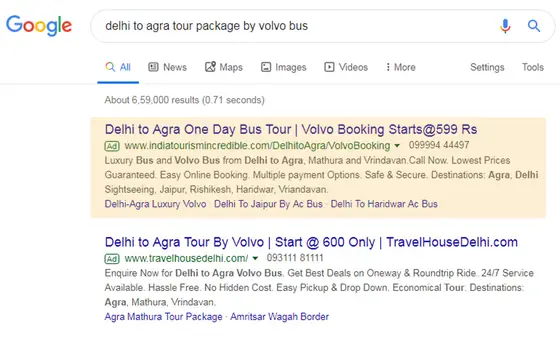
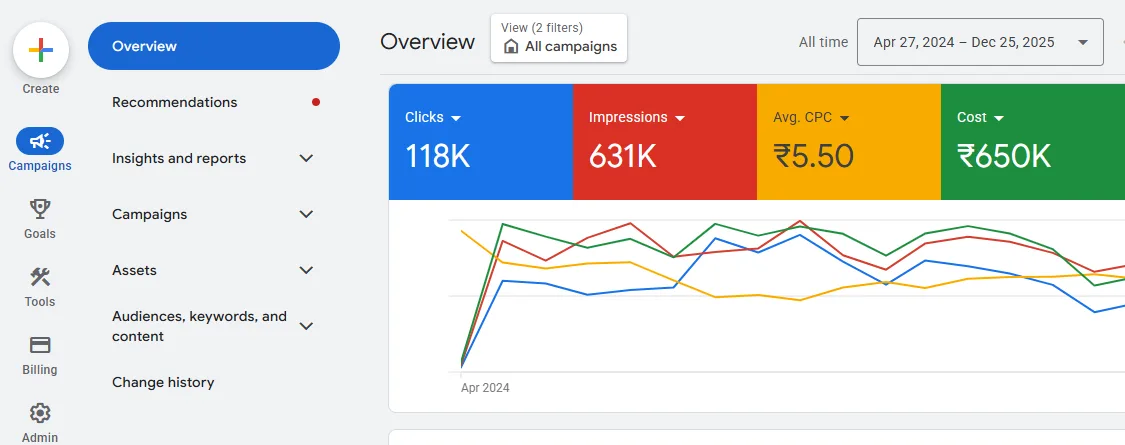
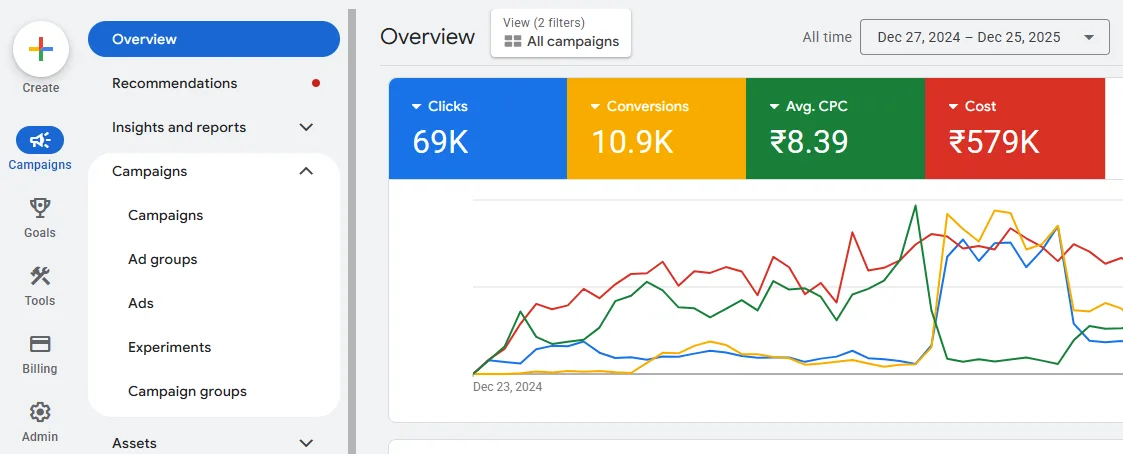
Screenshots taken straight from the India Tourism Incredible campaigns.
Click any one to see it full size.
Google Ads overview — Oct 2017 to Dec 2025Search ad — “delhi to agra tour package by volvo bus”
Screenshots are from a live account, cropped only to remove client billing details.
Nothing here is a mock-up.
The same trips sold twice — ₹299 on a shared bus or ₹1,999 in a private car. Two buyers, two budgets, and one account that had to stop them bidding against each other.
Google AdsPPC ServicesWebsite DesigningLead Generation
Tempo travellers from 9 to 26 seats. Nobody searches for “tempo traveller” — they search for the exact seat count their group needs, which makes the fleet the campaign structure.
Google AdsWebsite DesigningSEO ServicesLocal Promotion
Hundreds of packages across twelve Indian regions and six countries, sorted six ways by theme. A catalogue that size cannot be advertised — only the right slice of it can.
A heavy-haulage operator whose enquiries arrived by phone alone. The site had to explain over-dimensional cargo to a procurement manager and get a quote request out of them.
A neighbourhood pathology and radiology centre competing with national lab chains on the same search results page — and winning on proximity, price transparency and a phone call.
Low ticket prices do not mean low standards — they mean the account has to be stricter, not looser. Most of the work is deciding who not to show the ad to.
Campaigns structured around real search behaviour
Negative keyword lists built and maintained weekly